


Large Residential Developments in Delhi matter in established Delhi neighbourhoods because the city must fit far more homes onto land that cannot expand. Delhi covers about 1,484 sq.km, and the Master Plan for Delhi 2047, notified on 20 August 2026, plans for about 3.2 crore residents and around 40 lakh new homes. The plan’s rules for group housing and transit-linked density only apply to large, single parcels with wide road access. A big site inside a settled area is one of the few places where planned homes, open space and RERA protection can come together near a working metro line.
Benefits of Gated Community Living in Older Delhi Colonies
Most older colonies in West, North and Central Delhi were laid out as small residential plots. Each plot can be rebuilt on its own, but a street of rebuilt plots still has no shared park, no internal road and no common basement for cars.
A large parcel works differently. One approved layout can keep green areas for everyone, separate car movement from walking paths, and plan water storage, power backup and security for every home at the same time.
Location adds the second benefit. A gated complex inside a settled area puts new households next to metro stations, hospitals, schools and markets that already run, instead of at the city edge where roads and transit are still being built.
Delhi Master Plan 2047 Housing and Redevelopment Rules
The new 2047 master plan took effect on its notification in the Official Gazette and replaced the 2021 plan. Building plans approved under earlier plans remain valid, and the new norms apply only when an owner takes extra FAR or gets a revised plan sanctioned.
For plotted colonies, the 2047 plan allows only reconstruction at the prescribed FAR, and residential plots cannot be subdivided. Redevelopment in Delhi is allowed for government, employer, cooperative and DDA housing, subject to the same minimum plot size that applies to new apartment complexes.
New group housing in developed areas follows a separate standard under the plan:
- Maximum FAR of 200.
- Minimum plot of 3,000 sqm, or 2,000 sqm in Lal Dora areas.
- Access from a road with an 18 m right-of-way.
For a new apartment complex in an older part of the city, the land must already exist as one large parcel with a wide road in front of it.
TOD Policy Delhi: FAR, Plot Size and Road Rules
Transit Oriented Development is the part of the 2047 plan that allows the highest housing density in the city. Its rules set clear entry conditions:
- Zone: 500 m on each side of a metro line, and the same radius around RRTS, railway and high-speed rail stations.
- Plot: at least 2,000 sq m, with at least half of it inside the zone.
- Road: access from an existing road of that width, or a planned continuous road linked to one.
- FAR: base of 400 on payment of a fee, and a maximum of 500 on payment of additional charges.
- Use mix: at least 65 percent homes under 60 sq m carpet area, at least 10 percent shops and social amenities, and the rest flexible.
- Ground coverage of up to 40 percent, with parking at 1 ECS for every 100 sq m of FAR area.
Participation is voluntary, and plots that stay out keep their current master plan use. Because the smallest eligible plot is about half an acre, even high-density housing near metro corridors in Delhi depends on assembled land rather than single colony plots.
Builder Floor Vs Society Flat in Delhi
A builder floor is a full floor in a low-rise building on an individual residential plot. In Delhi’s plotted areas, the permitted FAR ranges from 200 to 350 depending on plot size.
A society flat is an apartment inside a gated housing complex. Owners share landscaped areas, a clubhouse, organised parking and managed security, and a single maintenance body runs the common services.
The practical differences for a buyer come down to 4 points:
- Privacy: an independent floor gives one family the whole level, while apartment owners share lifts and lobbies.
- Common spaces: a large complex has parks and amenities inside the gate, while a plot-based building depends on the colony park.
- Upkeep: floor owners split repairs among themselves, while a society collects a fixed maintenance charge.
- Regulation: a large complex must register under RERA, while a small plot-based building may fall outside it.
RERA Registration Rules for Small and Large Projects in Delhi
Section 3 of the RERA Act 2016 makes registration mandatory when a project’s land exceeds 500 sqm or has more than 8 apartments. A single-plot building within both limits can be sold without Delhi RERA registration.
Registration gives homebuyers 3 legal protections that an unregistered building cannot offer:
- A declared completion date, with interest payable to the buyer for delay under Section 18.
- 70 percent of buyer payments held in a separate account for that project’s land and construction under Section 4.
- 5 years of developer liability for structural defects after possession under Section 14.
Moti Nagar West Delhi: Metro Access and New Residential Projects
Moti Nagar is an older residential neighbourhood on the Blue Line of the Delhi Metro, close to Shivaji Marg and the Ring Road. The Shivaji Marg stretch already has 3 completed gated complexes with over 2,700 delivered homes, so planned apartment living has a long record here.
The next large project on this corridor comes from L&T Realty, the real estate arm of Larsen & Toubro. The upcoming L&T Moti Nagar Delhi project is pre-launching on the same corridor, with planned 3- and 4-BHK homes a short walk from Moti Nagar Metro Station.
The published amenity plan for L&T Moti Nagar apartments includes:
- A clubhouse, a temperature-controlled pool, and a wellness and spa zone.
- Co-working spaces, indoor games and social lounges.
- A jogging and cycling track, a yoga lawn, and sports courts.
- A senior citizen zone and a children’s play area.
- EV charging stations and smart security.
Large Residential Developments in Delhi, Families who want a gated community without leaving a familiar address can follow launch updates for the L&T Moti Nagar West Delhi project at LNT Moti Nagar Delhi, where the location details are live and the floor plans will be added at launch.
Read more blogs: https://www.lntmotinagardelhi.com/blog/
FAQs on Large Housing Projects in Delhi
What makes large housing projects important in older parts of Delhi?
They matter because Delhi cannot add land, yet it must house about 3.2 crore people by 2047. You get new homes next to working metro service, hospitals and schools, plus shared open space, parking and security. Large projects must also register under RERA, which gives you a fixed completion date and protected payments.
What are TOD charges in Delhi under MPD 2047?
The fee is ₹10,000 per sqm of FAR area up to a base FAR of 400. You pay additional charges at 20 percent of the prevailing circle rate for any area above that base, up to the maximum of 500. Both apply only to plot owners who choose to opt into the scheme.
Can old DDA flats be redeveloped under Delhi Master Plan 2047?
Yes, the Delhi Master Plan 2047 permits rebuilding DDA housing, cooperative housing societies, and government housing on plots of at least 3,000 sqm. The detailed procedure for these projects will be set out in separate regulations, which are yet to be notified, so the step-by-step process has yet to be published.
Is RERA applicable on builder floors in Delhi?
RERA applies to such a project only if the land is over 500 sqm or the project has more than 8 apartments. You may find that a small single-plot building falls outside registration, so you lose the declared completion date, the separate project account, and the 5-year structural defect cover that registered projects give.
How much can a builder take before the agreement for sale?
A builder cannot take more than 10 percent of the property cost as advance or application fee before signing a registered agreement for sale. This protection comes under Section 13 of the RERA Act 2016 and applies to every registered project in Delhi, including pre-launch bookings once the project receives its RERA number.
How big will the Delhi Metro network be by 2047?
Under the new master plan, the Delhi Metro network is planned to grow to about 695 km by 2047, along with 6 new RRTS corridors. This growth will matter for housing because the plan’s density rules allow the highest building density within 500 m of metro corridors and around RRTS and railway stations.
Is Moti Nagar a good area to live in Delhi?
Moti Nagar suits families who want a well-connected address in West Delhi. You get Blue Line metro access, the Ring Road nearby, and quick links to Rajouri Garden, Punjabi Bagh, and Karol Bagh, along with BLK-Max Super Speciality Hospital, Moments Mall, and N.C. Jindal Public School in the surrounding area.
When will L&T Moti Nagar Delhi launch?
L&T Realty has not yet announced the launch date for this project, and it will share prices, sizes and the RERA number closer to launch. You can follow updates at LNT Moti Nagar, which lists the planned 3 and 4 BHK homes, the full amenity plan, the project location and the latest launch news.
Related reading

Everyday Conveniences to Evaluate Before Buying a Home in Moti Nagar
Is Moti Nagar a good place to live? On everyday convenience, yes. Moti Nagar is an established West Delhi locality with its…
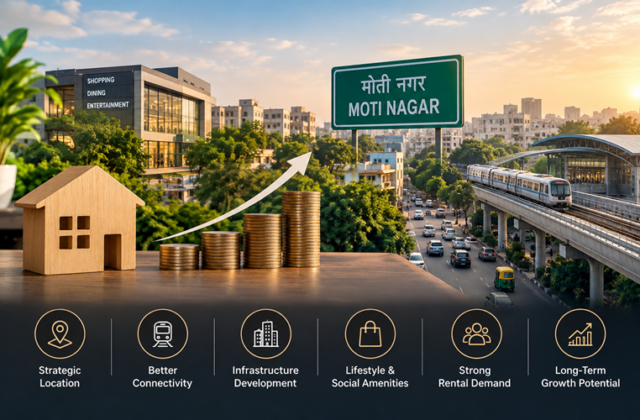
Factors That May Influence Property Appreciation in Moti Nagar, Delhi
Property Investment Moti Nagar depends on 5 measurable factors: scarce land for new high-rises, MPD 2047, metro reach, builder activity and rental…