

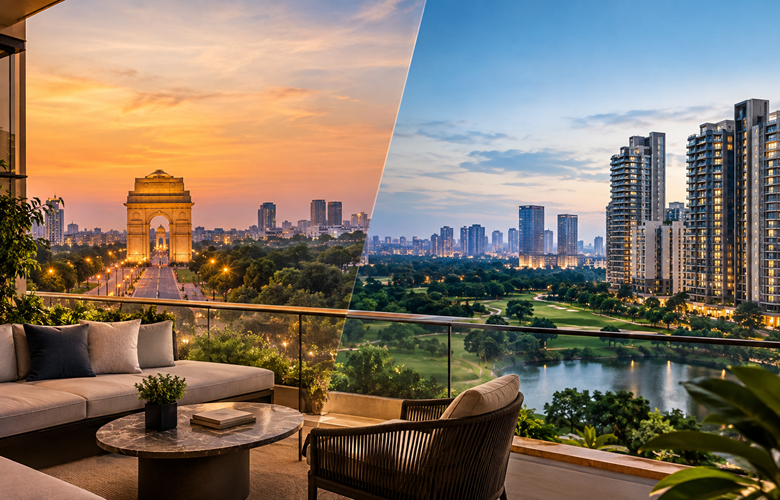
Luxury Housing in Delhi vs NCR is shaped by a structural reality that NCR satellite cities do not face: the city has 1,483 square kilometres of total land, almost no greenfield sites left for large-scale development, and a regulatory framework under the DDA Master Plan that restricts where new high-rises can come up. In 2026, fewer than 10 institutional-grade luxury high-rise projects are active across all of Delhi, while Gurgaon alone absorbed 87 percent of NCR’s luxury launches in a single quarter. This scarcity is why every new residential project in Moti Nagar, South Delhi, or North Delhi is absorbed differently from a comparable Gurgaon launch.
The entry of builders like L&T Realty, DLF, TARC, Godrej, and Eldeco into Delhi’s luxury high-rise segment marks a turning point. For 3 decades, Delhi’s luxury market was dominated by builder floors and plotted colonies. The L&T Moti Nagar Delhi residential project is part of a small, concentrated wave of organised high-rise supply that is giving Delhi buyers institutional-grade homes inside the city for the first time.
KEY TAKEAWAYS
- Delhi’s average residential price is approximately ₹25,200 per sq.ft. More than double Gurgaon’s ₹11,300 and nearly triple Noida’s ₹9,200 (ANAROCK, early 2025).
- Gurgaon accounted for 87 percent of luxury project launches across Delhi NCR in Q3 2025.
- Fewer than 10 institutional luxury high-rise projects are active across all of Delhi as of September 2026.
- South Delhi independent floor prices rose 6 to 21 percent year-on-year in Q2 2026.
- The DDA Master Plan 2047 emphasises redevelopment and high-rise housing within Delhi’s fixed land boundary.
- Stamp duty in Delhi is 6 percent for male buyers, 4 percent for female buyers, plus 1 percent registration.
Land Scarcity Inside Delhi vs Abundant NCR Corridors
Delhi has a total area of approximately 1,483 square kilometres. A large portion is already occupied by government zones, heritage areas, defence land, and established residential colonies. The DDA Master Plan 2047, approved in August 2026, focuses on redevelopment of existing group housing and CGHS flats rather than opening new land parcels. This means the total number of new luxury high-rise sites inside Delhi remains structurally limited.
Gurgaon, by contrast, has expanded outward through corridors like the Dwarka Expressway, Golf Course Extension Road, Southern Peripheral Road, and New Gurgaon sectors. Noida has extended through the Noida Expressway and Greater Noida West. These corridors offer abundant land, and developers can launch 10 to 15 luxury projects on a single stretch. The supply dynamics are fundamentally different. Luxury Housing in Delhi vs NCR.
For a buyer considering luxury housing in Delhi, this scarcity is not a disadvantage. It means fewer competing projects, faster absorption, and an address that does not get diluted by 20 more towers in the next 3 years. Every new project inside Delhi, whether it is the L&T Moti Nagar Delhi development on Shivaji Marg or a South Delhi ultra-luxury launch, enters a market with very little comparable inventory.
The Institutional Builder Wave Changing Delhi’s Luxury Landscape
Until recently, luxury apartments in Delhi vs NCR was not a meaningful comparison because Delhi simply lacked organised luxury high-rises. The city’s premium segment was defined by builder floors in colonies like Greater Kailash, Panchsheel Park, and Defence Colony.
That has changed. The active builder list in Delhi now reads like a who’s who of Indian real estate:
- DLF: DLF One Midtown in Moti Nagar (913 units, possession targeted July 2026) and DLF King’s Court in Greater Kailash II
- TARC Developers: TARC Kailasa in Kirti Nagar (3.5 and 4.5 BHK, under construction) and TARC Tripundra in Bijwasan (OC received)
- Godrej Properties: Godrej South Estate in Okhla and Godrej Connaught One near CP
- L&T Realty: L&T Moti Nagar in West Delhi (3 BHK and 4 BHK luxury apartments on Shivaji Marg) and a newly acquired 2.5-acre central Delhi land parcel
- Eldeco: Eldeco Camelot, a recent Delhi entry targeting the luxury high-rise segment
- Unity Group: The Amaryllis in Karol Bagh, one of Delhi’s longest-running luxury tower projects
This is the first time in Delhi’s history that 6 or more institutional developers are simultaneously building luxury high-rises inside the city. For NCR, that is an ordinary quarter. For Delhi, it is a generational shift.
Address Permanence Vs Corridor Momentum
In Gurgaon and Noida, a luxury address is typically 5 to 15 years old. Golf Course Road, the Dwarka Expressway, and Sector 150 Noida are all corridors that did not exist in their current form a decade ago. These addresses gain value from infrastructure momentum: new metro lines, expressway completions, and commercial hubs.
Delhi’s luxury addresses work differently. Moti Nagar, Kirti Nagar, Karol Bagh, New Friends Colony, and Greater Kailash are neighbourhoods where families have lived for 40 to 60 years. Schools, hospitals, markets, and social networks are already established. A buyer choosing L&T Moti Nagar does not need to wait for infrastructure to arrive. Shivaji Marg, Moti Nagar Metro, Kirti Nagar Metro, Rajouri Garden market, and the entire West Delhi social fabric are already in place.
This distinction matters for buyers who value stability over speculative upside. NCR corridors may deliver 12 to 15 percent annual appreciation during a bull run. Delhi’s luxury segment moves slower in percentage terms but on a much higher base, and the address does not depend on a single infrastructure trigger to hold its value.
Price Per Square Foot: A Different Equation
Comparing luxury apartments in Delhi vs NCR on price alone is misleading. Delhi’s average residential price is approximately ₹25,200 per sq.ft. Gurgaon averages about ₹11,300. Noida is approximately ₹9,200. The numbers suggest Delhi is more expensive, and it is.
But the comparison needs context. In Gurgaon, a luxury 3 BHK on Golf Course Extension Road starts at approximately ₹3 to 4 crore. In West Delhi, the L&T Moti Nagar Delhi residential project offers 3 BHK and 4 BHK configurations at institutional quality, in a neighbourhood where comparable options didn’t exist until now. Buyers aren’t paying more for the same product in a different geography. They are paying for a structurally different asset: limited supply, a permanent address, established infrastructure, and a city with no room to create competing inventory.
Stamp Duty, Registration, and Transaction Costs
Delhi’s stamp duty is 6 percent for male buyers and 4 percent for female buyers, with a 1 percent registration fee. An additional 1 percent MCD transfer duty applies on properties above ₹25 lakhs, bringing the total transaction cost to 7 to 8 percent for most buyers. Haryana’s stamp duty for Gurgaon is 7 percent for male buyers and 5 percent for female buyers, with a 0.1 percent registration fee. Noida, governed by UP’s stamp duty structure, charges 7 percent for male and 6 percent for female buyers.
Female buyers in Delhi get the most favourable stamp duty treatment in the NCR region at 4 percent, which can reduce the upfront cost on a ₹5 crore property by ₹10 lakh compared to a male-owned purchase in Gurgaon.
What Our Advisory Desk Sees on the Ground in West Delhi
Our team has tracked every institutional-grade luxury launch inside Delhi since 2021. The pattern is consistent: every new high-rise announcement in Delhi gets absorbed faster than comparable Gurgaon launches because the total pool of options is smaller. Buyers here are not comparison-shopping 15 projects. They are choosing between 3 or 4.
A family in Rajouri Garden recently spent 18 months evaluating Gurgaon GCER projects. They visited 8 sites, compared floor plans, and reviewed amenity lists. Then they came back to West Delhi. Their children’s school is 2 kilometres from Moti Nagar. Their parents live in Patel Nagar. They do their weekly grocery run at Rajouri Garden market. The decision was not about specifications. It was about where their life already is. They chose L&T Moti Nagar for institutional build quality inside their own neighbourhood.
“In NCR, you choose a project. In Delhi, you choose an address. That distinction is what makes every new residential project in Moti Nagar a fundamentally different buying decision.”
The Core Distinction for Buyers Evaluating Delhi and NCR
Delhi and NCR are not competing markets. They serve different buyer priorities. Here is what the data and on-ground reality confirm:
- Delhi has fewer than 10 active institutional luxury high-rise projects; Gurgaon launches that many in a single quarter.
- Delhi’s price per sq ft is approximately 2x Gurgaon’s, but the asset class is structurally different: limited supply, permanent address, and established infrastructure.
- L&T Realty, DLF, TARC, Godrej, and Eldeco are all simultaneously active in Delhi for the first time, creating a rare supply window.
- Female buyers save the most on stamp duty in Delhi at 4 percent, the lowest in NCR.
- The L&T Moti Nagar Delhi residential project gives West Delhi families institutional-grade luxury without relocating to an NCR corridor.
For a closer look at floor plans, configurations, and availability at L&T Moti Nagar, the project’s detail pages on this site carry the latest updates.
Read more blogs:https://www.lntmotinagardelhi.com/blog/
Frequently Asked Questions
What makes luxury housing in Delhi different from Gurgaon and Noida?
Luxury housing in Delhi is defined by land scarcity, address permanence, and a very limited number of institutional high-rise projects. Delhi has approximately 1,483 square kilometres with almost no greenfield sites left, while Gurgaon and Noida have expanding corridors with abundant new supply. This structural difference means Delhi projects get absorbed faster with less competing inventory.
Which builders are currently active in Delhi’s luxury high-rise segment?
As of 2026, DLF, L&T Realty, TARC Developers, Godrej Properties, Eldeco, and Unity Group all have active luxury high-rise projects inside Delhi. This is the first time 6 or more institutional developers are building luxury towers in the city simultaneously. L&T Moti Nagar Delhi and DLF One Midtown are among the prominent West Delhi launches.
How does the price per square foot in Delhi compare with Gurgaon?
Delhi’s average residential price is approximately ₹25,200 per square foot, compared with Gurgaon’s approximately ₹11,300 and Noida’s approximately ₹9,200 as of early 2025. Delhi commands a higher base price because of limited supply, established infrastructure, and permanent addresses that do not depend on new corridor development to hold value over time.
What is the stamp duty on luxury property in Delhi in 2026?
Stamp duty in Delhi is 6 percent for male buyers and 4 percent for female buyers, with a 1 percent registration fee. An additional 1 percent MCD transfer duty applies on properties above ₹25 lakhs. Female buyers in Delhi pay the lowest stamp duty in NCR, which can reduce upfront costs by ₹10 lakhs on a ₹5 crore property.
Is the L&T Moti Nagar Delhi residential project a good option for West Delhi families?
L&T Moti Nagar is designed for families already rooted in West Delhi. The project offers 3 BHK and 4 BHK luxury apartments on Shivaji Marg, near Moti Nagar Metro and Kirti Nagar Metro. It delivers institutional build quality by L&T Realty in an established neighbourhood, so buyers don’t need to relocate to an NCR corridor for modern amenities.
Why are new residential projects in Moti Nagar generating buyer interest?
Moti Nagar is one of the few West Delhi localities where institutional developers have launched organised luxury high-rises. With DLF One Midtown and L&T Moti Nagar both active on or near Shivaji Marg, the area now offers a choice that did not exist 3 years ago. Proximity to 2 metro stations, Rajouri Garden market, and established schools adds to the draw.
How does the DDA Master Plan 2047 affect luxury housing supply in Delhi?
The DDA Master Plan 2047, approved in August 2026, focuses on redevelopment of existing group housing and CGHS societies rather than opening new greenfield sites. This means Delhi’s luxury supply will remain structurally limited. You can expect more high-rise redevelopment in established localities, but the total number of large new-launch sites will stay small.
Should I buy luxury property in Delhi or wait for more options in NCR?
That depends on your priority. If you value address permanence, established social infrastructure, and low competition from future supply, Delhi is the better fit. If you want larger floor plates, extensive clubhouse amenities, and a wider selection of projects, NCR corridors like Gurgaon GCER and Dwarka Expressway offer more inventory at a lower price per square foot.
Related reading

Weekend Lifestyle Moti Nagar Delhi: Malls, Dining & Entertainment
Weekend Lifestyle Moti Nagar Delhi, has evolved into one of West Delhi’s practical lifestyle neighborhoods, where a normal weekend can move easily…
Why Property in Moti Nagar Delhi Offers a Proven Long-Term Investment Case
Property in Moti Nagar Delhi has appreciated 62.5% over 5 years, with apartment prices now averaging ₹19,828 to ₹22,950 per sq.ft. The…